

The Law Beneath the Law
Why the same principle governs bridges, bacteria, and boardrooms
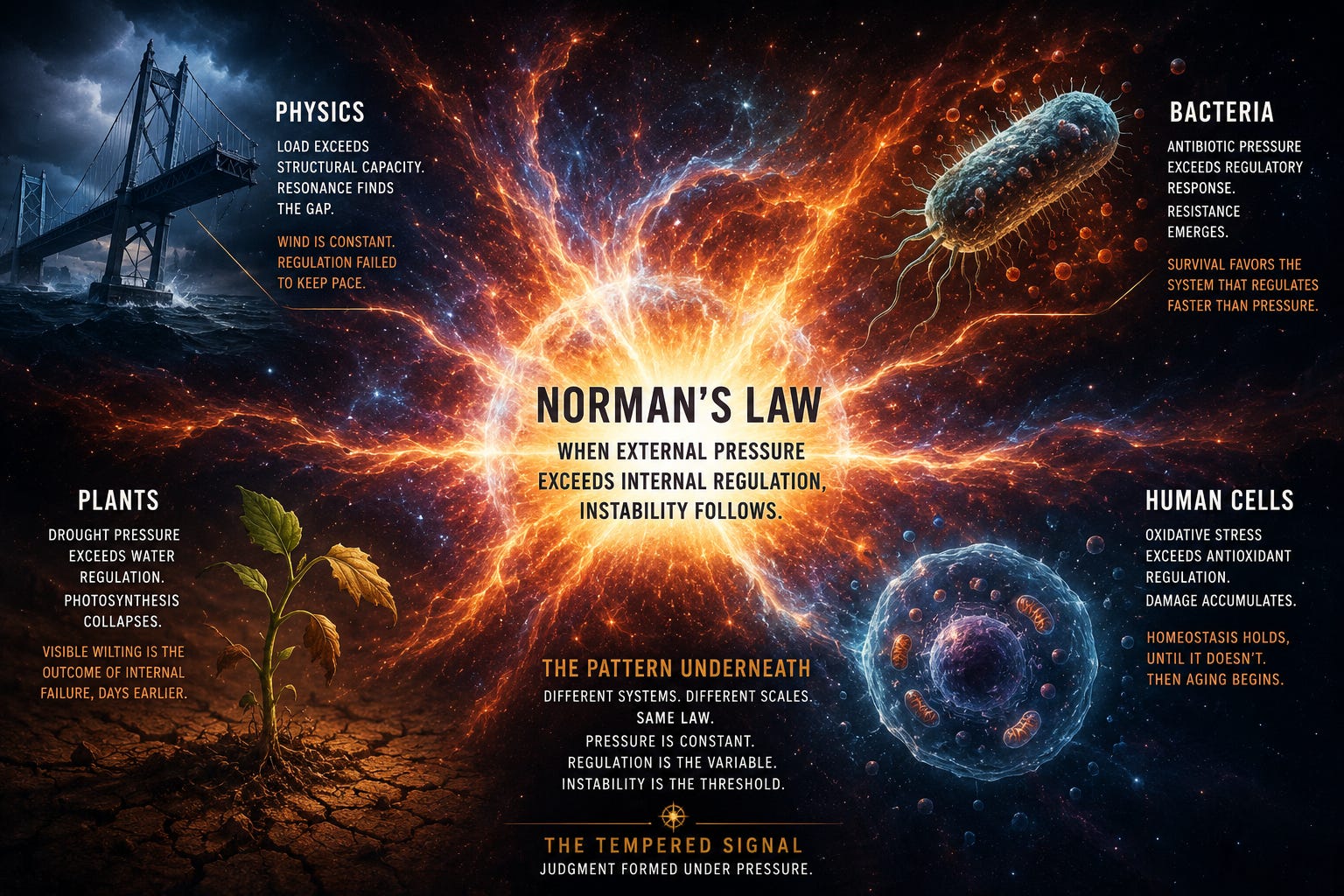
Norman’s Law states it plainly: when external pressure exceeds internal regulation, instability follows.
It reads like a leadership principle. It is actually a physical one. Organizations obey it because organisms obey it. Organisms obey it because the underlying systems, chemical, structural, cellular obey it first. The law didn’t start in the boardroom. It just got named there.
Here is the same law, observed at four different scales.
Physics
A bridge does not fail because wind exists. Wind is constant. Bridges are built for it.
A bridge fails when the load traffic, ice, resonance, torque exceeds what the structure was engineered to absorb. The Tacoma Narrows Bridge did not fall to a storm. It fell to a moderate, steady wind that found the one frequency its dampers weren’t built to regulate.
The gap between load and capacity was small at first. Then it oscillated. Then it was catastrophic. Nothing about the wind changed. What changed was that regulation fell behind pressure, cycle after cycle, until the failure condition was met.
Bacteria
A bacterial cell facing antibiotic pressure has one internal system: gene expression regulating efflux pumps, cell wall synthesis, and stress-response proteins.
As long as that regulatory system can up-regulate fast enough to match the external chemical pressure, the cell survives. When the drug concentration exceeds what the regulatory machinery can compensate for, the cell dies or, more dangerous, a resistant mutation slips through, and the survivors’ descendants inherit a wider gap between pressure and vulnerability.
Antibiotic resistance is not the bacteria getting smarter. It is Norman’s Gap, run across billions of trials, until one system’s regulation finally outpaces the pressure applied against it.
Plants
A drought-stressed plant closes its stomata to conserve water, a regulatory response to external pressure. This works, within a range. But closed stomata also block the carbon dioxide intake the plant needs for photosynthesis.
If the drought is brief, internal regulation, stored water, root depth, stomatal control, exceeds the pressure, and the plant recovers before damage accumulates. If the drought persists past what root depth and water storage can buffer, the gap widens past the plant’s capacity. Chlorophyll degrades. The visible wilting is not the failure. It is the outcome of a failure that occurred internally, days earlier, at the cellular level, unseen.
Human Cells
A cell under oxidative stress from inflammation, toxins, or normal metabolic byproducts relies on internal antioxidant systems to regulate the damage: glutathione, catalase, superoxide dismutase.
Healthy regulation keeps pace with pressure indefinitely. This is simply called homeostasis, and it draws no attention. But when reactive oxygen species outpace the cell’s antioxidant capacity, the gap becomes measurable: lipid peroxidation, protein misfolding, DNA damage. Left unregulated across enough cycles, this is not just cell stress. It is the mechanism underneath aging itself, pressure that never stops, regulation that slowly loses ground.
The Pattern Underneath
None of these systems know about each other. The bridge has never met the bacterium. The plant has no knowledge of the cell it resembles.
And yet the shape of failure is identical every time. Pressure is a given. Regulation is the variable. Instability is not a mystery event, it is a threshold crossed, quietly, before anyone was watching for it.
This is why Norman’s Law is not a metaphor borrowed from biology and dressed up for leadership. It is the same law, observed at a different scale. An organization under market pressure, a leader under decision load, a cell under oxidative stress, a bridge under wind each is asking the identical question in a different vocabulary:
Can regulation keep pace with pressure long enough to avoid the moment it can no longer be corrected?
The physics doesn’t care what industry you’re in. It never has.
Norman’s Law: When external pressure exceeds internal regulation, instability follows.*
The Tempered Signal: Judgment formed under pressure.
This is such a clear way to explain why collapse often looks sudden from the outside, even when the failure began much earlier on the inside.
The line that stood out to me most was that pressure is the given and regulation is the variable. That feels true far beyond physics or organizations. We often focus on the pressure itself—stress, change, conflict, uncertainty—but the deeper question is whether the inner structure has been formed enough to absorb it.
I also appreciated the point that visible failure is often only the outcome of an internal failure that happened quietly before anyone saw it. That applies to bridges, systems, leadership, and honestly, people too.
Failure doesn't come from the outside. It comes from within, but sometimes we only see it when it's too late. It all comes down to how you choose to listen to your own limits before they start screaming.