

The $125B capex line decided the layoff. The CEO is just announcing it.
THE SIGNAL
What happened On May 20, Meta begins cutting roughly 8,000 employees (10% of its workforce) while cancelling 6,000 open requisitions, with a second wave telegraphed for H2 2026.
The 2026 AI capex guidance: $115–$145B, nearly double in 2025.
Why it matters, Meta’s CFO told analysts on the Q1 call the cuts will “help to offset the substantial investments we are making.”
This is a financing decision wearing a strategy uniform. Layoffs at a profitable, record-stock company are funding the capex line not the other way around.
What shifts next.
Every leader watching is being trained, by example, that decisive-looking action and decisive thinking are the same thing.
The window is now.
This isn't a productivity move. It's a treasury move. Get that wrong, and the cost shows up the next time you're deciding what to build, buy, or fund.
THE FAILURE POINT
What the signals were, and when.
The capex trajectory was visible eighteen months ago.
The numbers were visible by Q3 2025. The scale AI spend set the pace. The Q4 earnings call named the pressure. A standard review of spending vs. staffing would have caught it.
Why they were missed.
Not an information failure.
An interpretation failure.
The capex announcement was read as ambition; the workforce implication was read as separate.
Inside Meta, those two decisions never sat in the same meeting until the Q1 2026 earnings call made the link in public.
The break wasn't May 20. It was the quarter no one was in a room weighing the spending against the headcount. By the time the memo went out, the cuts weren't a decision anymore. They were arithmetic.
SIGNAL WITHIN THE SIGNAL
Framework: Signal Compression · Norman’s Law
The pattern is repeating, a decision made by the balance sheet is being staged as a moment of leadership conviction.
The re-organisation into AI pods preceded the cuts by weeks.
The structure was the announcement; the announcement was the implementation. Speed without ownership of what actually moved.
What leaders are missing.
The driver, reading the AI pod reorg as the cause.
It is the cover.
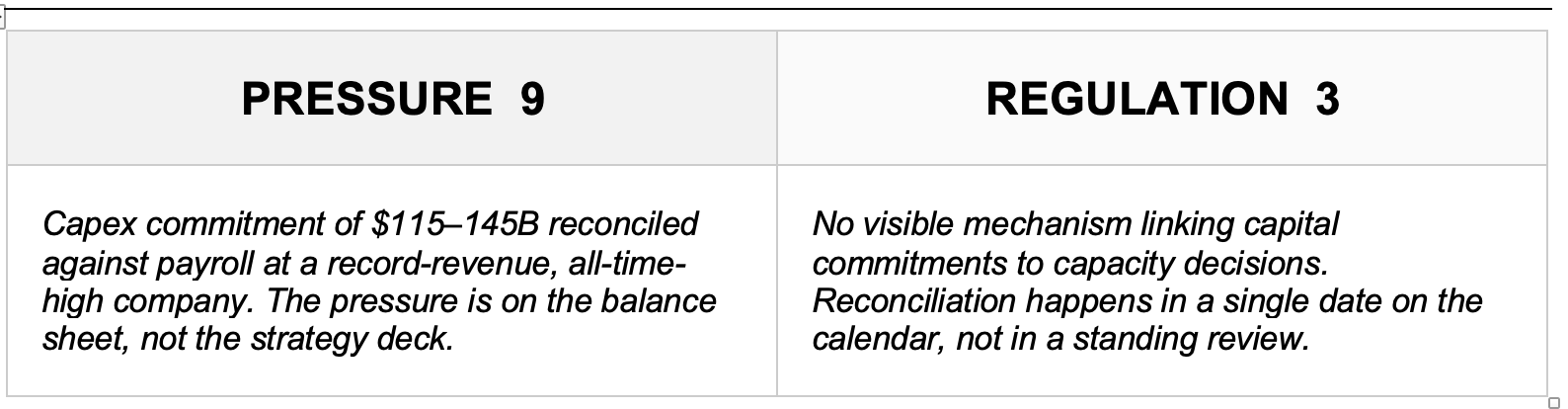
The cause is a $145B commitment without an operating system capable of absorbing it at the existing run-rate.
Where signal is being compressed, In the gap between what the balance sheet decided and what the announcement said it decided. The compression threshold: any time a workforce decision is described as “offsetting” a capital decision in the same sentence, two distinct decisions have been fused into one frame.
That is the trigger.
BEHAVIOR UNDER PRESSURE
What leaders did, they explained a Capex driven reduction as an AI productivity bet.
The CFO named the offset on the call. The CEO didn’t address the cuts directly. The internal memo arrived early because it leaked, not because it was ready.
What the correct question was, “If we strip the AI framing, what are we actually doing on May 20, and to whom?”
That question was answerable on the Q1 call, by the same people who took the analyst questions.
Why they didn’t ask it. The internal permission structure rewards conviction language and punishes arithmetic language. Naming a financing decision as a financing decision in front of the market is read as weakness. So, the frame compresses upward.
What this behavior is actually called, Strip the relationship vocabulary.
This is not “transformation.” This is not “a leaner operating model.”
This is funding a capital program by reducing payroll at a profitable company and choosing not to say so out loud.
Re-name it, narrative substitution under Capex pressure.
SYSTEM DRIVER - MOS + external & internal (MOSEI)
The one MOS directive. Every multi-year capital commitment is paired, at the same forum, with the headcount and capacity assumption that funds it. No exceptions, no separate decks.
The trigger to install. Before the Capex commitment is announced externally, not after. The reconciliation belongs in the planning cycle, not the earnings call.
What most systems are built to do.
Treat capital planning and workforce planning as parallel processes that meet only at the budget.
The upgrade is structural:
one meeting
one document
one decision
Decisions made together travel together. Decisions made separately get reconciled later, in public, by someone’s career.
LEADER DRIVER - INTERNAL OPERATING SYSTEM (IOS) - REGULATE
The internal pressure right now.
The urge to make the decision look like vision when it is actually arithmetic. To convert a financing trade into a strategy narrative because the strategy narrative is what the room expects.
The thirty-second self-audit. Two things that feel identical, with different costs: “I am being decisive” and “I am being legible.” The first earns the operating system. The second earns the press cycle. They are not the same move.
What trained leaders do differently.
They name the driver to themselves before they name it to anyone else. One sentence, internal, before the room. The window stays open because the language stays accurate.
IF YOU DO ONE THING TODAY
Find one decision your team is calling ‘strategic’ this quarter that is actually structural, forced by a number on a different page.
Name the real driver out loud, in the next meeting, in one sentence.
Deliberation cost vs. delay cost.
Deliberating one more week protects the press cycle. Delaying the naming costs you the survivors’ trust on the next cycle. The survivors are watching which version you trust.
Do not delegate. The means, the leader reading this has to do this themselves. Don’t hand it to your communications team to draft. Don’t route it through HR. Don’t make it a memo someone else writes for you. The action belongs to your seat, in your own words.
Do this at the next meeting where a real decision is being made, not a status update, not a check-in. Whatever’s already scheduled on your calendar where money, headcount, or direction is on the table.
That’s the deadline.
PRESSURE / REGULATE
FINAL SIGNAL
When the operating system can’t carry the pressure, the leader carries it, and every announcement after that is a confession dressed as a decision.
CTA
Subscribe to The Tempered Signal.
Send this to the leader who is about to call a structural decision a strategic one.
SOURCES
Primary source: Meta Q1 2026 earnings call (CFO Susan Li commentary on workforce reduction as capex offset); internal memo from Chief People Officer Janelle Gale, late April 2026; Reuters confirmation of May 20 effective date. Supporting data: Meta 2026 capex guidance ($115–$145B), 2025 capex baseline (~$72B), reorganisation into AI pods under Alexandr Wang’s Superintelligence Labs, 2022–2026 workforce trajectory (~40,000 positions eliminated since peak). Structural context: Cross-sector AI-narrative reductions at profitable companies (Cloudflare, Block, Amazon); industry shift toward treating workforce as a variable cost against AI infrastructure spend.
WHAT THE TEMPERED SIGNAL REVIEWS
The Daily Signal decodes global volatility, energy constraints, AI acceleration, operational pressure, and leadership response, turning noise into system-level clarity for leaders operating in real environments.
“And if you want the full training system - REGULATE is on Amazon.”
MOSei = Management Operating System + external & internal systems