

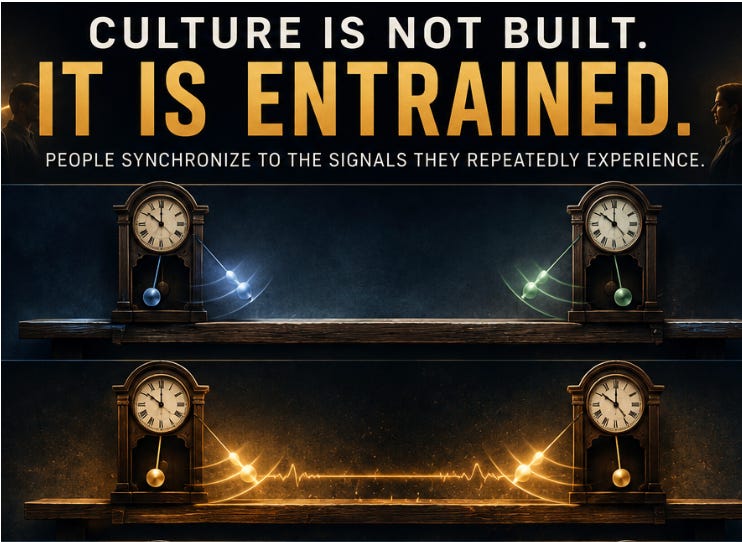
Culture Is Not Built. It Is Entrained.
Most organizations think culture is something you create. Write the mission statement. Define the values. Launch the engagement survey. Print the poster.
Then wonder why nothing moves.
Culture isn’t something people read. It’s something people synchronize to.
In 1665, the Dutch physicist Christiaan Huygens mounted two pendulum clocks on the same wooden beam. They started out swinging independently. Within a few hours, they matched. Separate them, and they drift apart again. Put them back, and they fall back into rhythm within the day.
Nothing mystical about it. Tiny vibrations moved through the shared beam. Each clock nudged the other until the system settled into one pattern.
Physicists call it synchronization, and it shows up everywhere. Fireflies flash together. Heart cells beat together. Neurons fire in step. Musicians lock into a shared tempo without anyone counting out loud. Independent systems fall into coordination because they never stop exchanging signals.
Organizations do the same thing. Not through vibration. Through information.
Every day, leaders send thousands of signals. What gets measured. What gets ignored. Which meetings start on time and which start fifteen minutes late because the VP is always late. Who gets the credit. Which behaviors get rewarded, and which mistakes get quietly absorbed. Whether bad news travels up clean or gets sanded down at every layer.
Nobody hands a new employee a manual explaining the real culture. They watch the signals for a few weeks and adjust. That’s the whole onboarding process, whether anyone designed it or not.
This is why culture initiatives so often fail. The language changes. The signals don’t.
The values deck says collaboration. The bonus plan pays out on individual numbers. The mission statement says innovation. The first failed experiment gets someone quietly reassigned. The CEO gives a talk on transparency, then the leadership team spends the next offsite hiding the real numbers from each other.
Nobody synchronizes to a slide. They synchronize to what actually repeats.
This is why management operating systems matter more than most executives believe. A management operating system isn’t a stack of meetings, KPIs, dashboards, and escalation paths sitting next to each other. It’s the signal architecture of the company. The daily huddle sends a signal. The KPI on the wall sends a signal. The way an escalation gets handled, or doesn’t, sends a signal. Run them together over months and you get a rhythm. Culture is what that rhythm produces.
Most organizations try to fix culture directly. That’s backwards. Fix the signal. The culture follows. Fix the feedback loop. The culture follows. Fix how decisions actually get made, not how the org chart says they get made. The culture follows.
You don’t change a culture by talking about it more. You change it by changing what people live through every day, repeatedly, whether you’re watching or not.
This also explains why one leader can walk into a struggling division and turn it around in a year, while another says all the right things and watches nothing change. Leadership isn’t mainly communication. It’s signal generation. Every decision a leader makes broadcasts information whether they intend it to or not. Every reaction teaches the room what actually matters. Every inconsistency between the stated value and the observed behavior costs trust, and it compounds. Eventually the organization moves together, not because everyone agrees, but because everyone has adapted to the same rhythm.
A system acts on what it believes is happening, not necessarily on what is happening. That’s the older idea. Here’s the addition to it: an organization becomes what it repeatedly synchronizes to.
Culture isn’t a poster. It isn’t a values list. It isn’t a survey score sitting in a slide deck once a year.
It’s the synchronization of behavior around the signals that actually repeat.
If you want to know what an organization’s culture really is, don’t ask what its values are. Watch its meetings. Watch its metrics. Watch what gets rewarded and what gets quietly let go.
The rhythm tells you everything the poster doesn’t.
Organizations don’t scale values. They scale signals.
Subscribe to: Tempered Signal
I really enjoyed the article; it resonated deeply with me. It's a topic I reflect on often. If you want to shift culture as a leader, don't begin with a grand speech. Begin with an uncomfortable question: What signals am I unconsciously sending that undermine what I claim to stand for?
This was pretty good. Lots of thought-worthy ideas. Cheers.